


ISO 22000 in India How Food Safety Certifications Transform Quality and Trust

A single unsafe ingredient can damage a brand, trigger a recall, and put thousands of consumers at risk. In a country as large and food-diverse as India, that risk is not theoretical. Food moves through farms, mandis, cold chains, processing plants, cloud kitchens, retail shelves, and export channels before it reaches a plate.
That is where ISO 22000 matters.
ISO 22000 is an international food safety management standard. It helps food businesses identify hazards, control risks, train people, document processes, and improve over time. For India’s food industry, it has become more than a certificate on a wall. It is a practical system for building food safety, product consistency, and trust.
The need is clear. The World Health Organization estimates that unsafe food causes around 600 million cases of foodborne illness and 4,20,000 deaths globally every year. The World Bank has estimated that unsafe food costs low and middle-income countries about USD 110 billion each year in lost productivity and medical expenses. India, with its large population and fast-growing packaged food, dairy, seafood, snacks, beverages, and ready-to-eat sectors, has a major stake in reducing that burden.
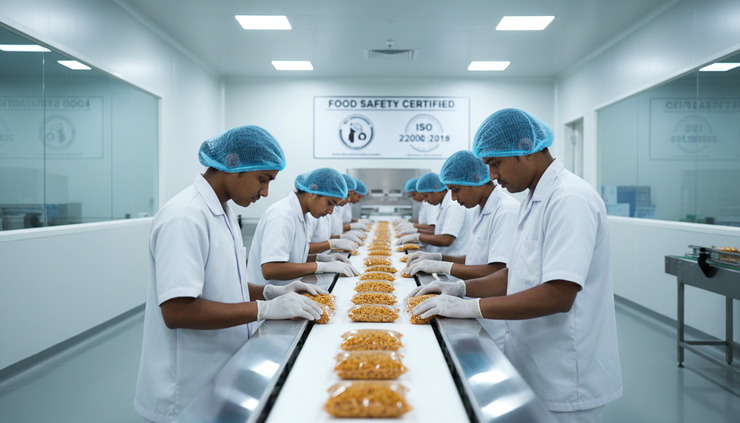
What ISO 22000 changes inside a food business
ISO 22000 brings structure to something every food business already wants: safe, consistent food. The difference is that it turns intent into a repeatable system.
At its centre, the standard combines:
Hazard analysis
The business identifies biological, chemical, physical, and allergen-related risks.
Control measures
Teams define how to prevent or reduce hazards at critical points.
Prerequisite programmes
These include cleaning, pest control, water quality, personal hygiene, equipment maintenance, and supplier checks.
Traceability
Ingredients, batches, production dates, and dispatch records must be traceable.
Corrective action
When something goes wrong, the business must record it, fix it, and prevent it from happening again.
Continual improvement
Audits, reviews, training, and performance checks keep the system alive.
This is especially relevant in India because food supply chains can be complex. A packaged dairy product may depend on milk collection centres, chilling units, tankers, processing plants, packaging suppliers, cold storage, distributors, and retailers. A spice exporter may source from many farms and handle risks such as pesticide residues, adulteration, microbial contamination, and foreign matter.
ISO 22000 does not replace Indian regulations. Food businesses still need to follow the Food Safety and Standards Authority of India requirements. The certification adds a recognised management system that helps businesses meet legal, customer, and export expectations in a disciplined way.
How certification improves food safety and quality management
Many food safety failures do not happen because people are careless. They happen because systems are weak. Instructions are unclear. Cleaning is not verified. Suppliers are approved informally. Temperature checks are missed. Records are kept only when an inspector is expected.
ISO 22000 reduces those gaps.
It makes risk visible before food reaches consumers
Under ISO 22000, a food business studies each step of production and asks a simple question: what can go wrong here?
In a ready-to-eat food plant, that may include microbial growth after cooking. In a seafood unit, it may include temperature abuse during storage. In a bakery, it may include allergen cross-contact between nut and non-nut products. In a spice grinding unit, it may include metal fragments, dust, or adulterants.
Once teams identify hazards, they define measurable controls. That could mean:
Cooking to a defined temperature
Rapid chilling within a set time
Metal detection before packing
Allergen segregation
Approved supplier lists
Batch-wise testing
Water quality checks
Cleaning verification
The result is fewer decisions based on memory and more decisions based on evidence.
It strengthens traceability during recalls
Traceability is one of the biggest practical gains from ISO 22000. If a batch has a problem, the company should be able to identify where the raw material came from, which line made the product, where it was shipped, and which other batches may be affected.
That saves time during a recall. It also reduces waste because the company can isolate the affected batch rather than withdrawing everything.
For producers, good traceability protects business continuity. For consumers, it reduces exposure to unsafe products.
It creates a quality culture, not only a safety checklist
Food safety and quality are closely linked. A plant that controls hygiene, temperature, storage, sanitation, and supplier quality is more likely to produce consistent food.
ISO 22000 encourages teams to document standard operating procedures, train workers, measure performance, and review complaints. Over time, this changes daily behaviour. Operators know why a step matters. Supervisors act on deviations. Management sees food safety as a business priority rather than a compliance task.

Indian companies show how ISO 22000 works in practice
Different parts of India’s food industry have adopted ISO 22000 and related food safety systems in different ways. Large companies often use ISO 22000 or FSSC 22000 across facilities because major retailers, institutional buyers, and export customers expect documented food safety controls. FSSC 22000 is built on ISO 22000 and adds sector-specific requirements.
Nestlé India and the discipline of process control
Nestlé India operates in categories where consistency is critical, including dairy, nutrition products, noodles, chocolates, and beverages. Large packaged food companies of this kind typically depend on strict supplier approval, process validation, allergen management, hygiene controls, and batch traceability.
The lesson from companies such as Nestlé India is that certification works best when it is tied to day-to-day discipline. A system only helps if it reaches the shop floor. That means line workers understand sanitation rules, supervisors act on deviations, and quality teams have authority to stop unsafe production.
The wider impact is consumer confidence. Packaged foods are bought repeatedly. If taste, safety, packaging, and shelf life remain consistent, consumers are more likely to trust the brand.
Amul-linked dairy operations and cold chain control
India is the world’s largest milk producer, and dairy is one of the sectors where food safety systems matter most. Milk is highly perishable. It can spoil quickly if collection, chilling, processing, and distribution are not controlled.
Several dairy plants within India’s cooperative and private dairy sectors have adopted ISO-based food safety systems, including ISO 22000 or FSSC 22000 at specific facilities. For a dairy processor, the certification journey usually focuses on:
Hygienic milk collection
Chilling and transport temperature control
Pasteurisation validation
Cleaning-in-place systems
Water testing
Packaging hygiene
Cold chain monitoring
The case is useful because dairy safety depends on many small controls working together. A good plant cannot compensate for poor collection hygiene, and a strong cold chain cannot fix inadequate pasteurisation. ISO 22000 pushes the business to look at the full chain.
ITC Foods and supplier quality at scale
ITC Foods works across packaged staples, snacks, biscuits, ready-to-eat products, and other categories. A business of that size depends on large supplier networks and many raw materials, including wheat, spices, oils, flavours, packaging materials, and additives.
For such companies, certification supports supplier governance. It helps define approval criteria, incoming quality checks, storage norms, allergen controls, and non-conformance handling. This matters because food safety risks often enter through inputs before production begins.
The lesson for smaller producers is clear. Certification is not only about the factory. It also covers the suppliers, transporters, storage partners, and service providers that affect food safety.
Benefits for consumers and producers
ISO 22000 creates value on both sides of the food chain. Consumers get safer and more reliable products. Producers get stronger systems, better market access, and fewer costly failures.
For consumers | For producers |
Lower risk of contamination when controls are followed properly | Better control over raw materials, processing, storage, and dispatch |
More consistent taste, texture, packaging, and shelf life | Fewer rejected batches and less rework |
Faster, more targeted recalls when problems occur | Stronger traceability and recall readiness |
Clearer confidence in organised food brands | Improved access to modern retail, institutional buyers, and exports |
Better protection for children, older adults, and vulnerable consumers | Stronger reputation and customer trust |
For exporters, the value can be even greater. Many international buyers expect suppliers to follow recognised food safety standards. ISO 22000 can support entry into global supply chains, especially in sectors such as seafood, spices, tea, processed foods, bakery ingredients, and ready-to-eat products.
For domestic producers, the business case is also strong. Large retailers, hotel chains, airlines, quick-service restaurants, and institutional kitchens often prefer suppliers with documented food safety systems. Certification can help a producer move from informal markets to higher-value channels.
Food safety certification does not guarantee that nothing will ever go wrong. It improves the odds by making risks visible, controls measurable, and accountability clear.
The challenges Indian businesses face during certification
The certification process is useful, but it is not always easy. Many Indian food businesses, especially small and medium enterprises, face real barriers.
Documentation can feel overwhelming
ISO 22000 requires procedures, records, audits, corrective actions, management reviews, and evidence of control. For a business used to verbal instructions, this can feel like a heavy shift.
A small snack maker, for example, may know the process well but may not have written specifications for frying temperature, oil quality checks, cleaning frequency, pest control, or supplier approval.
The solution is to keep documentation practical. A simple checklist that workers actually use is better than a long manual that sits untouched. Digital tools can also help with temperature logs, cleaning records, and batch tracking.
Training takes time and patience
Food safety systems depend on people. Workers need to understand hygiene, cross-contamination, allergens, reporting, and recordkeeping. Supervisors need to know how to investigate deviations. Managers need to review performance and fund improvements.
Training cannot be a one-day event before the audit. It should become part of routine operations. Short toolbox sessions in local languages often work better than long classroom sessions.
Infrastructure gaps can delay certification
Some facilities need physical improvements before certification. Common gaps include poor drainage, weak pest proofing, inadequate hand-washing stations, damaged floors, poor segregation between raw and cooked areas, and lack of temperature-controlled storage.
These upgrades cost money. The best approach is to prioritise by risk. Fix the gaps that affect food safety most directly, then plan phased improvements.
Supplier control is difficult in fragmented chains
Many Indian food businesses source from small farms, traders, mandis, and local vendors. Getting consistent documentation from every supplier can be hard.
Businesses can start by classifying suppliers by risk. High-risk ingredients need stronger checks, written specifications, testing, and periodic review. Over time, suppliers can be trained and assessed. Long-term relationships often improve compliance more than frequent supplier switching.

Practical ways to make ISO 22000 certification easier
Certification becomes manageable when businesses treat it as a phased improvement project rather than a last-minute audit exercise.
Start with a gap assessment
A gap assessment compares current practices with ISO 22000 requirements. It shows what is already working and what needs improvement.
The assessment should cover:
Facility hygiene and layout
Process flow
Food safety hazards
Supplier controls
Cleaning and sanitation
Pest management
Personal hygiene
Training records
Testing and inspection
Traceability and recall systems
Legal compliance
This prevents wasted effort. A business may discover that its main risk is not paperwork, but poor segregation between raw and cooked product zones.
Build a food safety team
ISO 22000 expects food safety responsibilities to be clear. The team should include people who understand production, quality, maintenance, purchase, stores, and dispatch.
In smaller companies, one person may handle more than one role. That is normal. What matters is accountability. Everyone should know who approves suppliers, who reviews test results, who stops production, and who investigates complaints.
Use simple records that match real work
Records should prove that controls happened. They should not become a burden that encourages false entries.
Useful records include:
Daily cleaning checklist
Temperature log
Metal detector verification record
Water testing record
Raw material inspection sheet
Pest control visit report
Batch production record
Complaint register
Corrective action report
The best formats are short, clear, and easy to fill at the point of work.
Prepare for audits through routine checks
Internal audits help businesses find problems before certification auditors do. They should not be treated as fault-finding exercises. A good internal audit asks whether the system works in practice.
If records show repeated cold storage temperature deviations, the answer is not to hide the records. The answer is to fix the equipment, retrain staff, or change monitoring frequency.
This is where certification delivers real value. It pushes businesses to solve recurring issues instead of accepting them as normal.
What the future looks like for food safety certification in India
India’s food industry is moving towards more organised, traceable, and quality-led systems. Several trends are making ISO 22000 more relevant.
Packaged food consumption is rising. Online grocery and food delivery have increased consumer expectations. Export markets remain strict on safety and documentation. Modern retail and institutional buyers want reliable suppliers. Consumers are also more aware of hygiene, labelling, allergens, and shelf life.
Government initiatives, FSSAI compliance requirements, state food safety ratings, and industry-led training are also pushing businesses towards better systems. Certification fits into this shift because it gives companies a structured way to prove control.
Technology will make adoption easier. Sensors can track cold chain temperatures. QR codes can support traceability. Cloud-based systems can store audit records. Mobile apps can help small plants record cleaning, dispatch, and inspection data.
Still, technology alone will not make food safe. The foundation remains the same: trained people, clean facilities, honest records, strong suppliers, and management that treats safety as non-negotiable.

The takeaway for India’s food industry
ISO 22000 helps Indian food businesses move from reactive safety to preventive control. It supports better hygiene, stronger traceability, clearer accountability, and more consistent quality. For consumers, that means safer food and greater confidence. For producers, it means fewer failures, better market access, and stronger brand trust.
The path to certification can be demanding. Documentation, training, infrastructure, and supplier control take effort. But the solutions are practical: start with risk, keep records simple, train often, improve facilities in phases, and treat audits as learning tools.
For India, where food is both a daily necessity and a major economic engine, ISO 22000 is not just a compliance badge. It is a way to protect public health, strengthen producers, and build trust in every packet, bottle, carton, and meal that reaches the table.


Comments